Student Spotlight: Prithi Srinivasan, 2026 Gates Cambridge Scholar
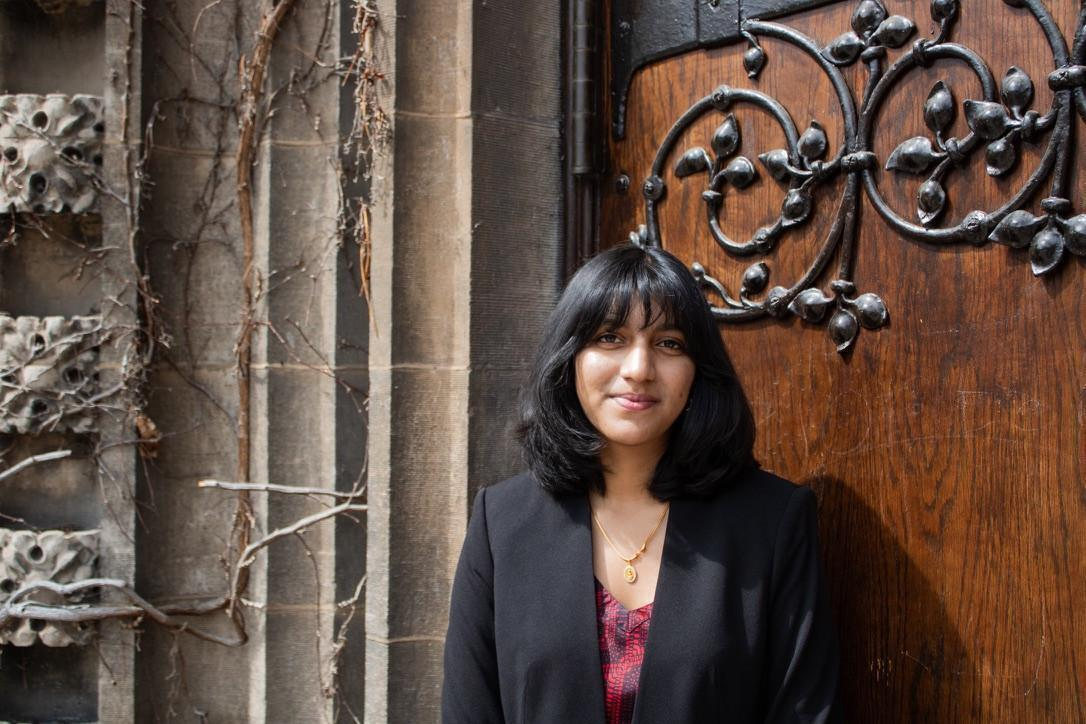
Every year, the Gates Cambridge Trust awards 80 students from around the world full scholarships for a post-graduate degree in any subject available at Cambridge University. This year, we are extremely pleased to celebrate one of our students - Prithi Srinivasan, a 4th year student double majoring in Biology & Chemistry - on being selected as a Gates Cambridge Scholar for 2026!
The Gates Cambridge Scholarship is not the first honor that Prithi has earned while at the University of Chicago, she also was named a Goldwater Scholar (’25), been a BSCD Summer Research Fellow (’23 & ’25), an Academic Year Quad Undergraduate Research Scholar (’24), a BSCD Chromatin and Epigenetics Research Fellow (’24), and a BSCD Academic Year Fellow (’23). Prithi has also been a member of the Ruthenburg Lab since 2022.
“Prithi is the platonic ideal of a University of Chicago undergraduate— it was clear she was on a glide path for this since her interview. I am grateful to have such wonderful undergraduate train in the lab.” Dr. Ruthenburg had to say of Prithi in light of this most recent honor.
Dr. Navneet Bhasin, having witnessed Prithi’s journey from 1st year on, had similar praise for her.
“From the very beginning, Prithi exhibited the skills of a good scientist - keen observer, hard worker and a logical thinker. If she didn’t understand something she was always sure to ask and then read up on it herself to be convinced. She exhibited a similar “scientific mindset" when she worked with me as a TA. She frequently stopped by my office to share stories from her experiences, talk enthusiastically about her research pursuits, and discuss her evolving goals for the future.”
Amanda Keplinger, a graduate student in the Ruthenburg Lab has been working with Prithi since she joined them in 2022. We reached her for a look back at how far Prithi has come:
“Since joining the lab as a freshman, Prithi has been tenacious through tricky experimental troubleshooting and has stepped outside of our lab's area of expertise to learn and execute new techniques. Working and publishing with her has been a graduate student's dream mentoring experience. I'm very proud of everything she has accomplished and excited that her talent and drive has been recognized by such a prestigious program.”
If you talk to any of the faculty that have worked with her, similar sentiments keep popping up - “model-student”, “dream mentee”, and “platonic ideal” - whether in the class or the lab. Her talents in the classroom also show up on the other side of the desk, having TA’d for every course in the Advanced Biology Sequence from her 2nd to 4th years, in addition to a number of other courses.
Check out an article that Prithi was an author on from the Ruthenburg Lab!
We sat down with Prithi to hear some of her reflections on the past 4 years, and asked her if she had any advice for other students that want to be Biological Science researchers:
What would you say was an important moment for you within the BSCD that helped you on your journey as a student and researcher?
I always say the Advanced Biology Sequence – taking that sequence first year was really the single most important thing that made me a biologist, because I wasn't actually going to major in biology when I first came here. I originally wanted to study economics and statistics, and I wanted to pursue research on educational inequality, because it’s something very important to me from my own experience existing in and looking into academic spaces. I took Advanced Biology because I had taken AP Biology in high school and thought, “Let’s just get the requirement done with right away.”
The first Advanced Biology lecture that I attended, I had effectively no background knowledge in biology; I had taken biology in high school over COVID, so we weren’t able to come in for labs, demonstrations, anything. In one of the first classes, we read a 1981 paper on the identification of a self-splicing ribosomal RNA. Going through it for the first time, everything was completely unfamiliar to me, from the system being studied, to even the logic behind their experimental design. I was sitting in lecture thinking, “I don't know anything, I have so much to catch up on.” But we broke down the paper methodically over the course of the week, considering the narrative that was being presented in the paper itself, and the likely steps that were taken by the authors themselves. It was the way that they were teaching us how to think about experiments from the framework of classical biochemistry that felt completely simple and beautiful to me. So, I stuck with it.
As a student on the Advanced Biology Sequence, Prithi is referring to the course, “Molecular Biology of the Cell” (BIOS 20234) with Dr. Bhasin, Dr. Ruthenburg, and Dr. Michael Glotzer.
Do you have any advice for your peers about becoming a researcher?
The biggest thing I have learned in my research experience is to not restrict yourself right off the bat with what you might be interested in. Many of my friends started out wanting to work in a wet lab, in genetics or bacteriology, and realized they’re ultimately more interested in public health and health equity research. But they had to try bench work first in order to find that out. I think it’s important to pursue work that you’re interested in that moment, but also to be flexible and let yourself be guided as your interests change over the years.
I had a very similar experience with the project I'm currently working on, looking at processes of protein import into the nucleus. The Ruthenburg Lab is primarily interested in chromatin biology, and a big driving interest of mine going in was contributing to a structural understanding of the mechanisms by which gene expression is regulated. I initially began working on a project attempting to probe the mechanism of actin transport into the nucleus, to better understand the many roles nuclear actin plays in managing chromatin organization. But over the years, my work has ended up shifting toward a cell biology-focused project instead, as I’ve come to consider the communication between nuclear actin and the actin cytoskeleton. I never would have considered entering the cytoskeleton space in my first year, but I’m now going to do a PhD in cell biology. It just kind of came together.
Is there anything during your study or research that that at one time felt like a crisis, but seems really trivial now in retrospect?
I think there is a good example of this in the research I have been doing in the Ruthenburg Lab. As I said, I went in wanting to study chromatin biology. While I had some level of knowledge about the many important genomic roles played by nuclear actin, I didn’t know too much about actin itself, or its normal behavior in the cell. For people who aren’t familiar, actin is a very challenging protein to work with because it spontaneously polymerizes and often binds non-specifically to everything – from other proteins to the microcentrifuge tubes you are using for a given assay. It is very difficult to control how it's acting in any kind of experiment.
In my first year, I was attempting to look at how monomeric actin could bind to its nuclear import chaperone to be brought into the nucleus, with a very seemingly straightforward binding assay. After a few months trying to optimize my experimental conditions, I ended up getting a result that suggested that actin monomers could be recognized and bound directly by the import chaperone for nuclear import. But because of the challenges of working with actin and controlling actin state in all my binding reactions, I spent two years trying to replicate that experiment, tweaking my conditions ever so slightly, trying to identify what I could change to make actin more experimentally tractable, and every time, I would get a different result. I guess there was a little bit of a crisis there. I was completely at a loss – I didn't have an immediate sense of what I could do to fix this problem or see how I could get out of the seemingly endless cycle.
I ultimately ended up talking to Dr. Ruthenburg, and he suggested that we start working more closely with the Kovar lab – really, actin cytoskeleton experts here at UChicago. From there, we could start to collaboratively think about how to develop experiments, and that was where things started to really take off. I could start to ask, “what kinds of techniques are not so common in chromatin biology, but very classical to the actin space that could really report on actin interactions with other proteins,” and that has made a huge difference in terms of the questions I’ve been able to ask and answer.
Where would you like to go with your current career trajectory?
I think I have always been interested in teaching in some capacity. I have been a teaching assistant for Advanced Biology since my second year and have more recently also worked with students in Biochemistry. Finding ways to excite people about really fundamental concepts and methods in molecular biology, in the lab and in the classroom, has been very rewarding. I’ve been especially floored by moments where students that I’ve taught before will come back and tell me about the research that they’re doing, and how much the courses they have taken have helped them grow as scientists. It’s incredible to think about how much these experiences in the classroom can transform not only students’ interests but also their long-term trajectories. Alongside teaching, I am really enamored by the process of research, and I hope to continue investigating questions relating to cellular transport and organization.
What is something you’re looking forward to at Cambridge?
There’s so many skills and methods that I am excited to learn. For example, when I first toured the Laboratory of Molecular Biology, I remember being in complete awe of the number and scale of their technical facilities. They have 5 Krios electron microscopes – I can completely immerse myself in structural work there; it’s an incredible scientific opportunity.
From a less scientific perspective - there’s a lot of yarn shops in the Cambridge area, and I have always wanted to go ‘punting on the river’. It’s not a long time to be there - it’s only a 4-year Ph.D., so I am hoping to experience everything the area has to offer.
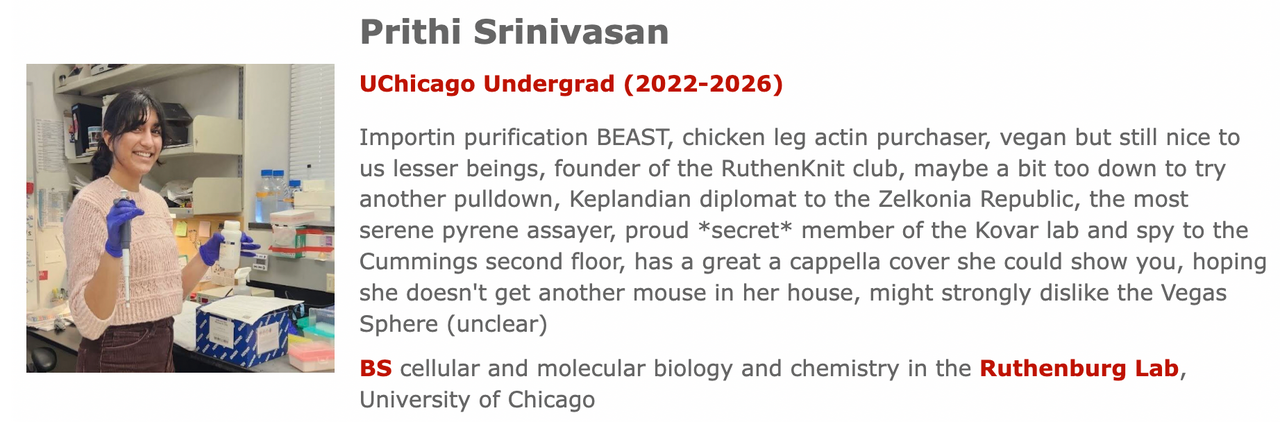
Prithi mentions 4 years as short, but in just 4 years’ time she found a love for biology and chemistry and pursued it to the scholastic end point here at the University of Chicago. Through her commitment to learning and to research Prithi has displayed a level of skill developed over prudent scholarship and diligent lab work that deserves every bit of recognition that she has earned. We are so excited to send her off this Spring with great excitement for what Cambridge has to offer, as well as whatever comes next.